Technology · British
Alan Turing
Also known as 艾伦·图灵
1912 — 1954
Mathematician and computing pioneer
A mathematician whose ideas helped define computation and whose wartime codebreaking contributed to the Allied effort.
Saved lives stay only on this device.
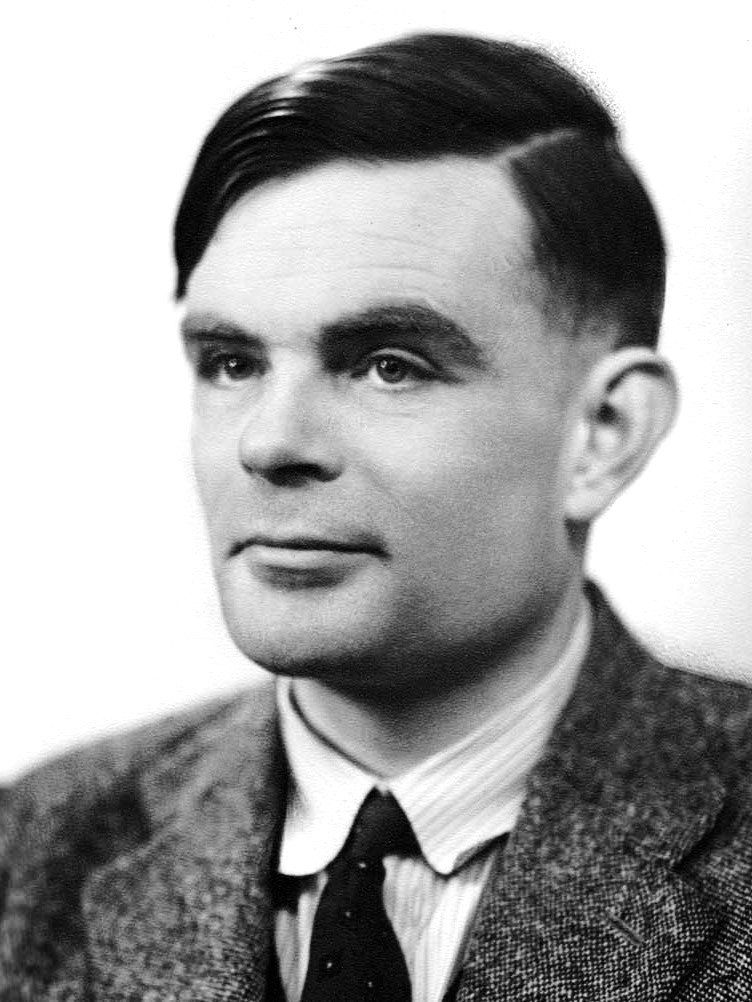
The life behind the name
A life, in context
Alan Turing studied mathematics at King's College, Cambridge, and approached questions that lie beneath everyday computing: what can a method calculate, and what are the limits of a mechanical procedure? His 1936 paper described an abstract computing machine and showed why some mathematical problems cannot be solved by a general algorithm.
During the Second World War, Turing worked at Bletchley Park. With colleagues, and building on earlier Polish cryptanalytic work, he helped develop methods and machinery for attacking German Enigma messages. This work was collective, secret, and technically demanding. After the war, he contributed to early computer design and studied the possibility of machine intelligence.
In 1950, he published a paper that asked how thinking machines might be discussed and evaluated. He also investigated mathematical explanations for patterns in living organisms. In 1952, Turing was convicted under laws criminalizing homosexual relationships and subjected to hormonal treatment. He died in 1954. Remembering him includes both his intellectual achievements and the injustice done to him, as well as the collaborators and institutions within which his work developed.
What they helped make possible
The legacy that continues
Turing helped establish the theoretical foundations of computer science, advanced wartime cryptanalysis, and influenced early computing and the study of artificial intelligence. His work on biological pattern formation connected mathematics with living systems. His history also asks institutions to consider how discrimination can damage lives and prevent people from contributing freely.
Moments along the way
A life in chapters
- 1936
On computable numbers
Published the paper introducing his abstract model of a computing machine.
- 1939
Wartime codebreaking
Began full-time work at Bletchley Park after Britain entered the war.
- 1950
Computing machinery and intelligence
Published an influential discussion of machines and intelligence.
- 1952
The chemical basis of morphogenesis
Published mathematical work on how biological patterns can emerge.
Remembered together
A place to remember together.
Leave a gesture, share a thought, and keep this life close.
Following is saved to your account across devices. “Save for later” keeps a separate bookmark in this browser.
Checking your account…
조용히 추억하는 시간.
관습과 믿음은 서로 다릅니다. 자신에게 맞는 방식을 자유롭게 선택하세요.
함께 남긴 추모
Thoughts on this life
Comments are reviewed before appearing publicly. Share a thoughtful reflection on this person’s life or work.
Suggest a profile correction
Help keep this public record accurate. Suggestions are reviewed before the profile is changed, and a source link is especially helpful for factual details.
Loading shared remembrance…
A personal practice
Carry something forward.
A legacy can begin with one small choice. Write for yourself; these words are never added to the public memorial.
Private to this browser. Turning saving off removes the saved copy. Download a copy to take it with you.
Not saved on this device.
Share this public story
A name, a story and a light to carry forward. This link opens the reviewed public page.
Create a memory book
Choose the stories to keep, arrange their chapters, and make a printable copy. Book edits apply to your exported copy.
Every life is a light. A story to keep.
8 selected chapters
Edit this chapter
Edit this chapter
Edit this chapter
Edit this chapter
Edit this chapter
Edit this chapter
Edit this chapter
Edit this chapter
Read further
Sources & further reading
Explore the published references behind this profile. These links open in a new tab.
- King's College, Cambridge — Alan Turing archive (opens in a new tab)turingarchive.kings.cam.ac.uk
- King’s College Cambridge — On computable numbers (opens in a new tab)turingarchive.kings.cam.ac.uk
- Portrait: Elliott & Fry · Public domain (opens in a new tab)commons.wikimedia.org
A place for your own remembrance
Is there someone you are remembering?
You can begin with a name and one memory. A private memorial space can hold photographs, stories and the dates your family returns to.
Private by default. You decide what to share.