Technology · Hungarian-American
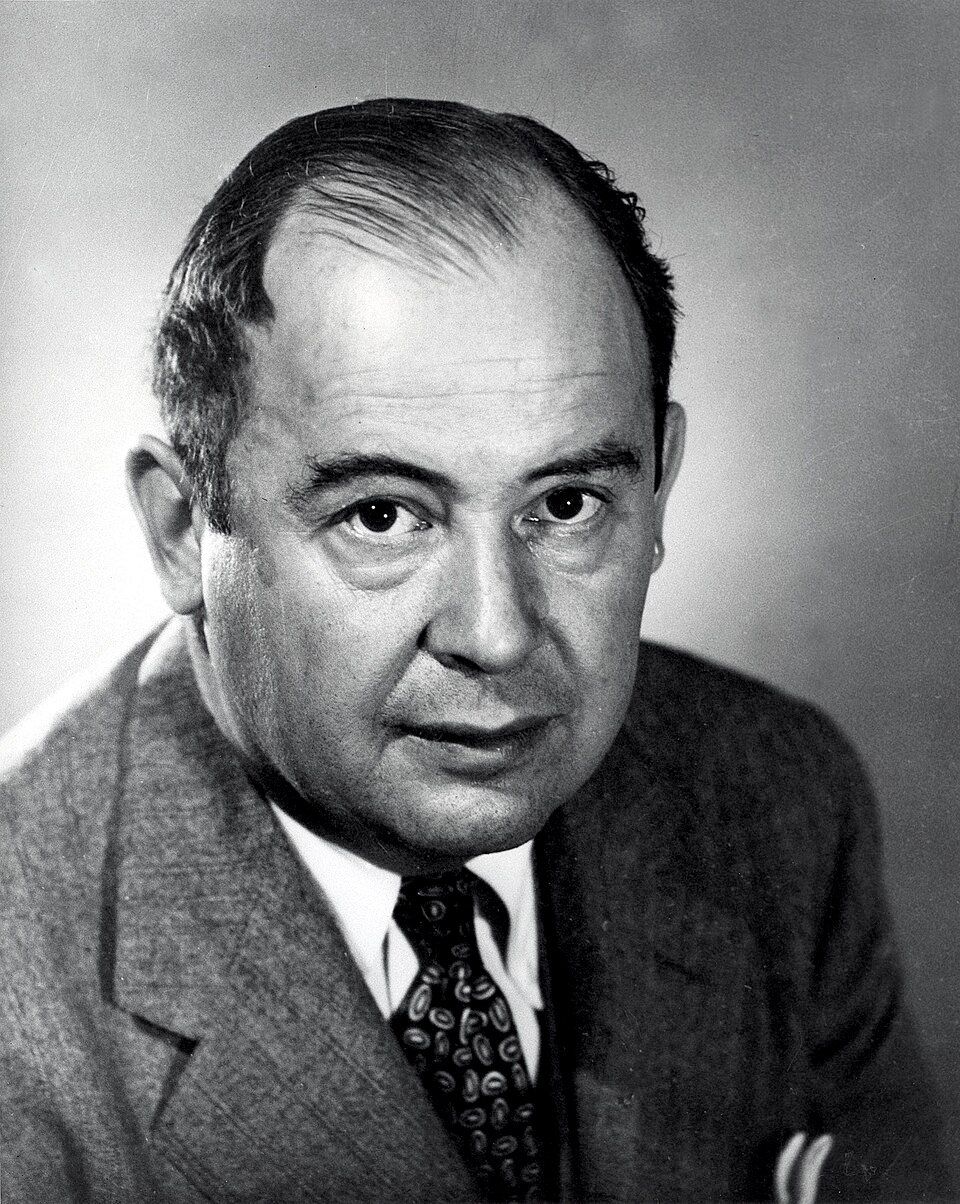
John von Neumann
Also known as 约翰·冯·诺伊曼
1903 — 1957
Mathematician and computing pioneer
A mathematician whose work ranged from quantum theory and game theory to early electronic computing.
Saved lives stay only on this device.
The life behind the name
A life, in context
John von Neumann was born in Budapest and studied mathematics and chemical engineering before developing a wide-ranging academic career. He contributed to set theory, functional analysis and the mathematical foundations of quantum mechanics. In 1933, he joined the Institute for Advanced Study in Princeton. His ability to move between abstract problems and practical calculations brought him into collaborations with mathematicians, economists, engineers and government institutions.
With Oskar Morgenstern, he published Theory of Games and Economic Behavior in 1944, helping establish a mathematical approach to strategic interaction. His involvement in electronic computing included the circulated First Draft of a Report on the EDVAC, which described a stored-program organization developed within a broader collaborative effort. He also studied numerical methods and self-reproducing automata. Wartime and later work involved nuclear weapons, making the consequences of military technology part of his historical legacy. He died in Washington at fifty-three. His influence spans several fields, while an accurate account recognizes both shared technical contributions and the public responsibilities attached to their use.
What they helped make possible
The legacy that continues
Von Neumann advanced several branches of mathematics, helped establish game theory and contributed to early stored-program computing and numerical analysis.
Moments along the way
A life in chapters
- 1933
Institute for Advanced Study
Became a founding faculty member in Princeton.
- 1944
Game theory
Published Theory of Games and Economic Behavior with Oskar Morgenstern.
- 1945
EDVAC report
Circulated an influential description of stored-program computer organization.
Remembered together
A place to remember together.
Leave a gesture, share a thought, and keep this life close.
Following is saved to your account across devices. “Save for later” keeps a separate bookmark in this browser.
Checking your account…
A quiet moment to remember.
Customs and beliefs differ. Choose a gesture that feels right to you; each is optional.
Shared moments of remembrance
Thoughts on this life
Comments are reviewed before appearing publicly. Share a thoughtful reflection on this person’s life or work.
Suggest a profile correction
Help keep this public record accurate. Suggestions are reviewed before the profile is changed, and a source link is especially helpful for factual details.
Loading shared remembrance…
A personal practice
Carry something forward.
A legacy can begin with one small choice. Write for yourself; these words are never added to the public memorial.
Private to this browser. Turning saving off removes the saved copy. Download a copy to take it with you.
Not saved on this device.
Share this public story
A name, a story and a light to carry forward. This link opens the reviewed public page.
Create a memory book
Choose the stories to keep, arrange their chapters, and make a printable copy. Book edits apply to your exported copy.
Every life is a light. A story to keep.
7 selected chapters
Edit this chapter
Edit this chapter
Edit this chapter
Edit this chapter
Edit this chapter
Edit this chapter
Edit this chapter
Read further
Sources & further reading
Explore the published references behind this profile. These links open in a new tab.
- Wikipedia — John von Neumann (opens in a new tab)en.wikipedia.org
- University of St Andrews — John von Neumann biography (opens in a new tab)mathshistory.st-andrews.ac.uk
- Portrait: ENERGY.GOV · Public domain (opens in a new tab)commons.wikimedia.org
A place for your own remembrance
Is there someone you are remembering?
You can begin with a name and one memory. A private memorial space can hold photographs, stories and the dates your family returns to.
Private by default. You decide what to share.