Science · English
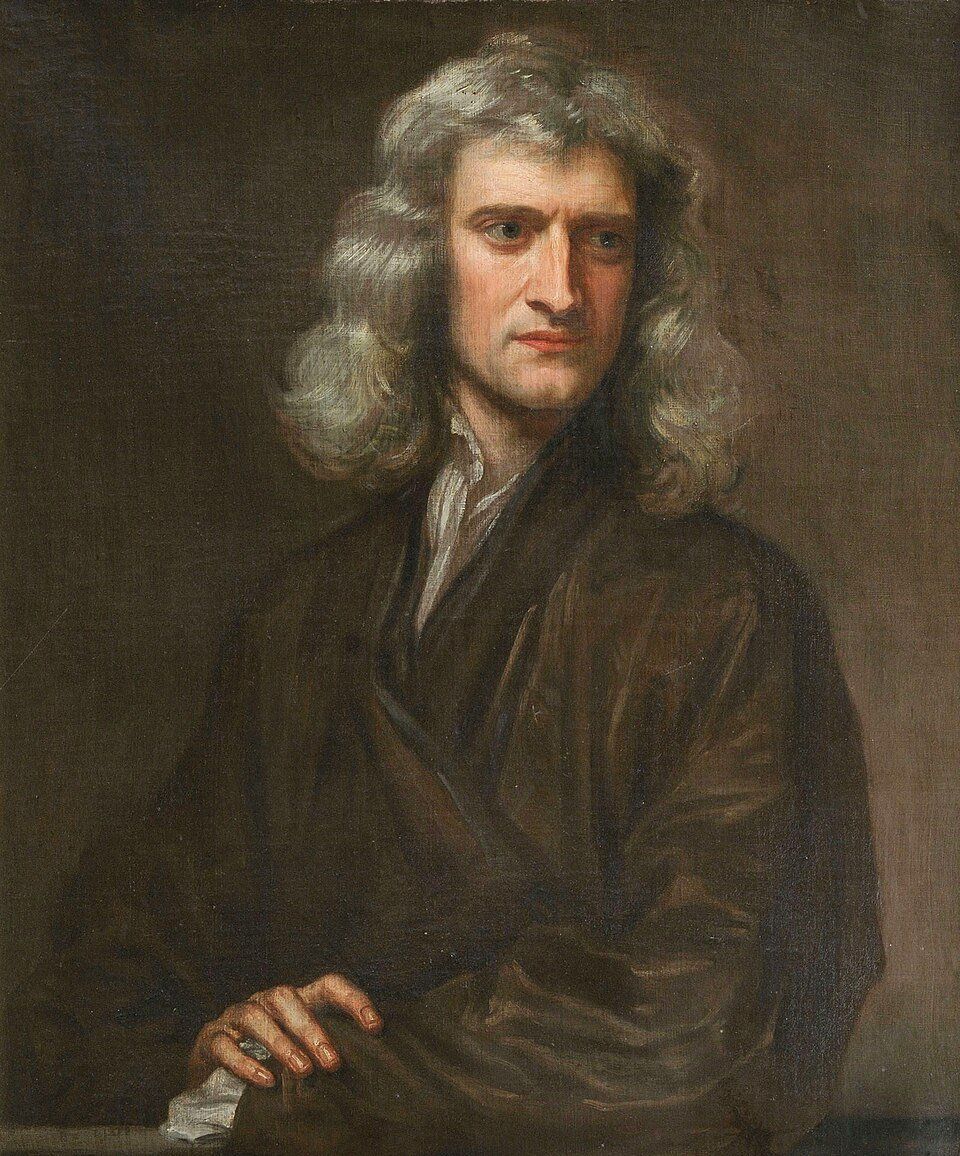
Isaac Newton
Also known as 艾萨克·牛顿
1643 — 1727
Mathematician, physicist and astronomer
A mathematician and physicist whose work connected the motion of objects on Earth with the movement of planets.
Saved lives stay only on this device.
The life behind the name
A life, in context
Isaac Newton grew up in rural Lincolnshire and studied at Trinity College, Cambridge. His investigations ranged across mathematics, mechanics and the behavior of light. During the university closures associated with the plague, he developed ideas that he would refine over many years. He studied the colors produced by a prism and built a reflecting telescope, bringing practical experiment together with mathematical reasoning. His development of calculus occurred independently of Gottfried Wilhelm Leibniz, whose notation later became widely used.
In 1687, Newton published the Principia, explaining laws of motion and universal gravitation through a powerful mathematical framework. The book connected falling objects, planetary orbits and other phenomena within a shared account of nature. His later Opticks explored light through experiments and questions for further research. Newton also served at the Royal Mint and became president of the Royal Society. His legacy includes remarkable discoveries, difficult disputes and the work of colleagues who tested and extended his ideas. It remains central to understanding how mathematical models can explain observations.
What they helped make possible
The legacy that continues
Newton established influential laws of motion and gravitation, advanced calculus and experimental optics, and helped make mathematical prediction a central method in physics.
Moments along the way
A life in chapters
- 1669
Lucasian Professor
Became Lucasian Professor of Mathematics at Cambridge.
- 1687
The Principia
Published his mathematical account of motion and gravitation.
- 1704
Opticks
Published an extensive study of light and color.
Remembered together
A place to remember together.
Leave a gesture, share a thought, and keep this life close.
Following is saved to your account across devices. “Save for later” keeps a separate bookmark in this browser.
Checking your account…
A quiet moment to remember.
Customs and beliefs differ. Choose a gesture that feels right to you; each is optional.
Shared moments of remembrance
Thoughts on this life
Comments are reviewed before appearing publicly. Share a thoughtful reflection on this person’s life or work.
Suggest a profile correction
Help keep this public record accurate. Suggestions are reviewed before the profile is changed, and a source link is especially helpful for factual details.
Loading shared remembrance…
A personal practice
Carry something forward.
A legacy can begin with one small choice. Write for yourself; these words are never added to the public memorial.
Private to this browser. Turning saving off removes the saved copy. Download a copy to take it with you.
Not saved on this device.
Share this public story
A name, a story and a light to carry forward. This link opens the reviewed public page.
Create a memory book
Choose the stories to keep, arrange their chapters, and make a printable copy. Book edits apply to your exported copy.
Every life is a light. A story to keep.
7 selected chapters
Edit this chapter
Edit this chapter
Edit this chapter
Edit this chapter
Edit this chapter
Edit this chapter
Edit this chapter
Read further
Sources & further reading
Explore the published references behind this profile. These links open in a new tab.
- Wikipedia — Isaac Newton (opens in a new tab)en.wikipedia.org
- University of St Andrews — Isaac Newton biography (opens in a new tab)mathshistory.st-andrews.ac.uk
- Portrait: Godfrey Kneller · Public domain (opens in a new tab)commons.wikimedia.org
A place for your own remembrance
Is there someone you are remembering?
You can begin with a name and one memory. A private memorial space can hold photographs, stories and the dates your family returns to.
Private by default. You decide what to share.