Science · New Zealand-born British
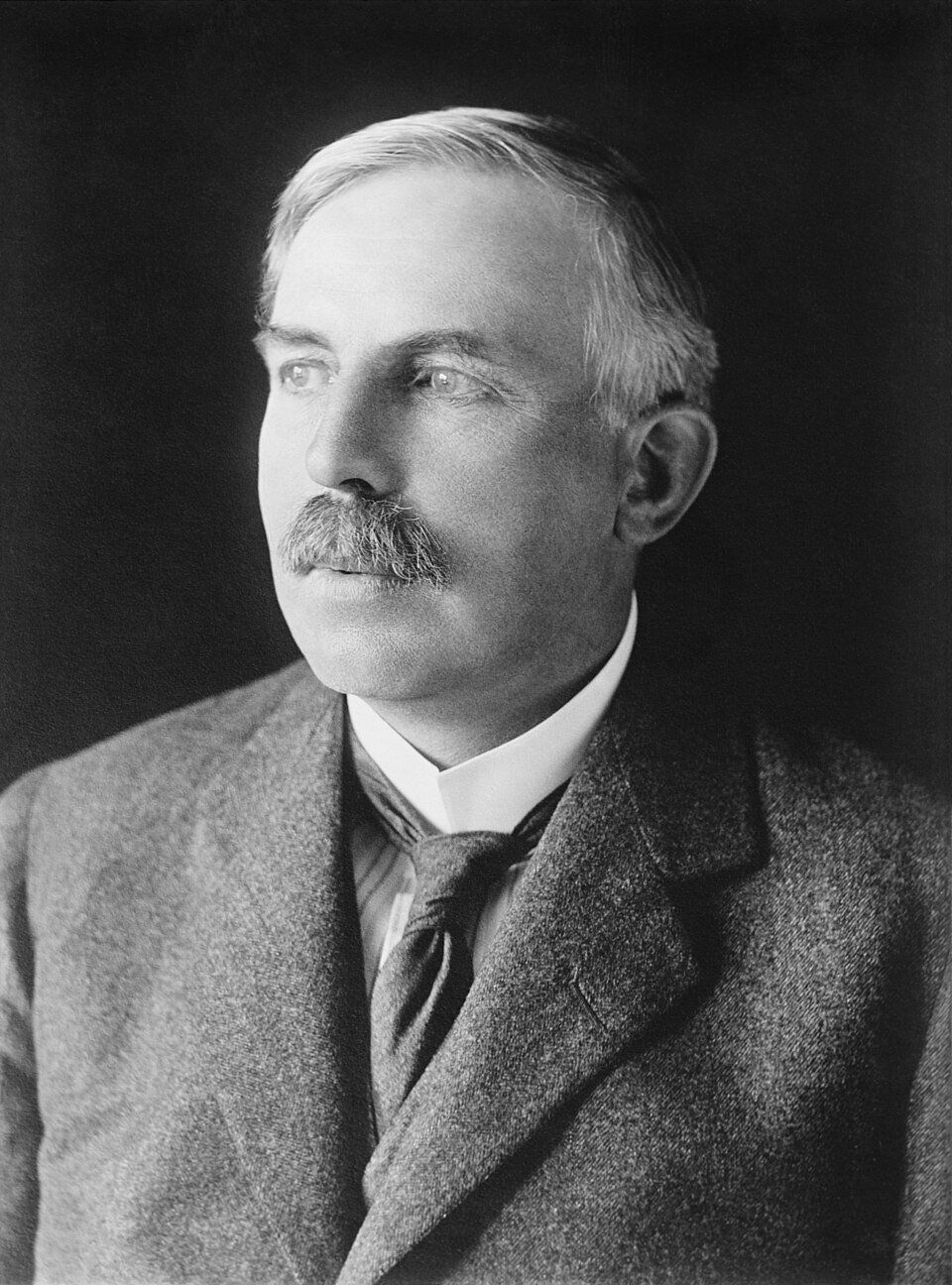
Ernest Rutherford
Also known as 欧内斯特·卢瑟福
1871 — 1937
Experimental physicist
An experimental physicist whose research revealed the atomic nucleus and helped establish nuclear physics.
Saved lives stay only on this device.
The life behind the name
A life, in context
Ernest Rutherford grew up in New Zealand and studied at Canterbury College before moving to Cambridge. His early research examined electrical and radioactive phenomena, and he later worked at McGill University and in Manchester. With Frederick Soddy, he developed an explanation of radioactive decay involving the transformation of elements. His experiments distinguished forms of radiation and helped turn radioactivity into a field with measurable processes and reliable predictions.
At Manchester, the scattering experiments performed by Hans Geiger and Ernest Marsden led Rutherford to propose a small, dense atomic nucleus in 1911. This interpretation changed the understanding of atomic structure and provided a starting point for later models. He received the 1908 Nobel Prize in Chemistry for earlier investigations of radioactive substances, and continued experiments involving nuclear transformations. As head of the Cavendish Laboratory, he supported a generation of influential researchers. His reputation rests on inventive experiments and interpretations, together with the work of students and collaborators who designed apparatus and gathered evidence. The resulting discoveries opened a field whose medical, scientific and military consequences extended far beyond his lifetime.
What they helped make possible
The legacy that continues
Rutherford clarified radioactive decay and proposed the nuclear atom. His experiments and laboratory leadership helped establish nuclear physics as an active research field.
Moments along the way
A life in chapters
- 1908
Nobel Prize in Chemistry
Recognized for studies of radioactive substances and elemental disintegration.
- 1911
The nuclear atom
Interpreted scattering results through a small, dense atomic nucleus.
- 1919
Nuclear transformation
Published experiments on nitrogen transformed through alpha-particle bombardment.
Remembered together
A place to remember together.
Leave a gesture, share a thought, and keep this life close.
Following is saved to your account across devices. “Save for later” keeps a separate bookmark in this browser.
Checking your account…
A quiet moment to remember.
Customs and beliefs differ. Choose a gesture that feels right to you; each is optional.
Shared moments of remembrance
Thoughts on this life
Comments are reviewed before appearing publicly. Share a thoughtful reflection on this person’s life or work.
Suggest a profile correction
Help keep this public record accurate. Suggestions are reviewed before the profile is changed, and a source link is especially helpful for factual details.
Loading shared remembrance…
A personal practice
Carry something forward.
A legacy can begin with one small choice. Write for yourself; these words are never added to the public memorial.
Private to this browser. Turning saving off removes the saved copy. Download a copy to take it with you.
Not saved on this device.
Share this public story
A name, a story and a light to carry forward. This link opens the reviewed public page.
Create a memory book
Choose the stories to keep, arrange their chapters, and make a printable copy. Book edits apply to your exported copy.
Every life is a light. A story to keep.
7 selected chapters
Edit this chapter
Edit this chapter
Edit this chapter
Edit this chapter
Edit this chapter
Edit this chapter
Edit this chapter
Read further
Sources & further reading
Explore the published references behind this profile. These links open in a new tab.
- Nobel Prize — Ernest Rutherford facts (opens in a new tab)www.nobelprize.org
- Wikipedia — Ernest Rutherford (opens in a new tab)en.wikipedia.org
- Portrait: Bain News Service, publisher Restored by: Bammesk · Public domain (opens in a new tab)commons.wikimedia.org
A place for your own remembrance
Is there someone you are remembering?
You can begin with a name and one memory. A private memorial space can hold photographs, stories and the dates your family returns to.
Private by default. You decide what to share.