Care & public service · Scottish
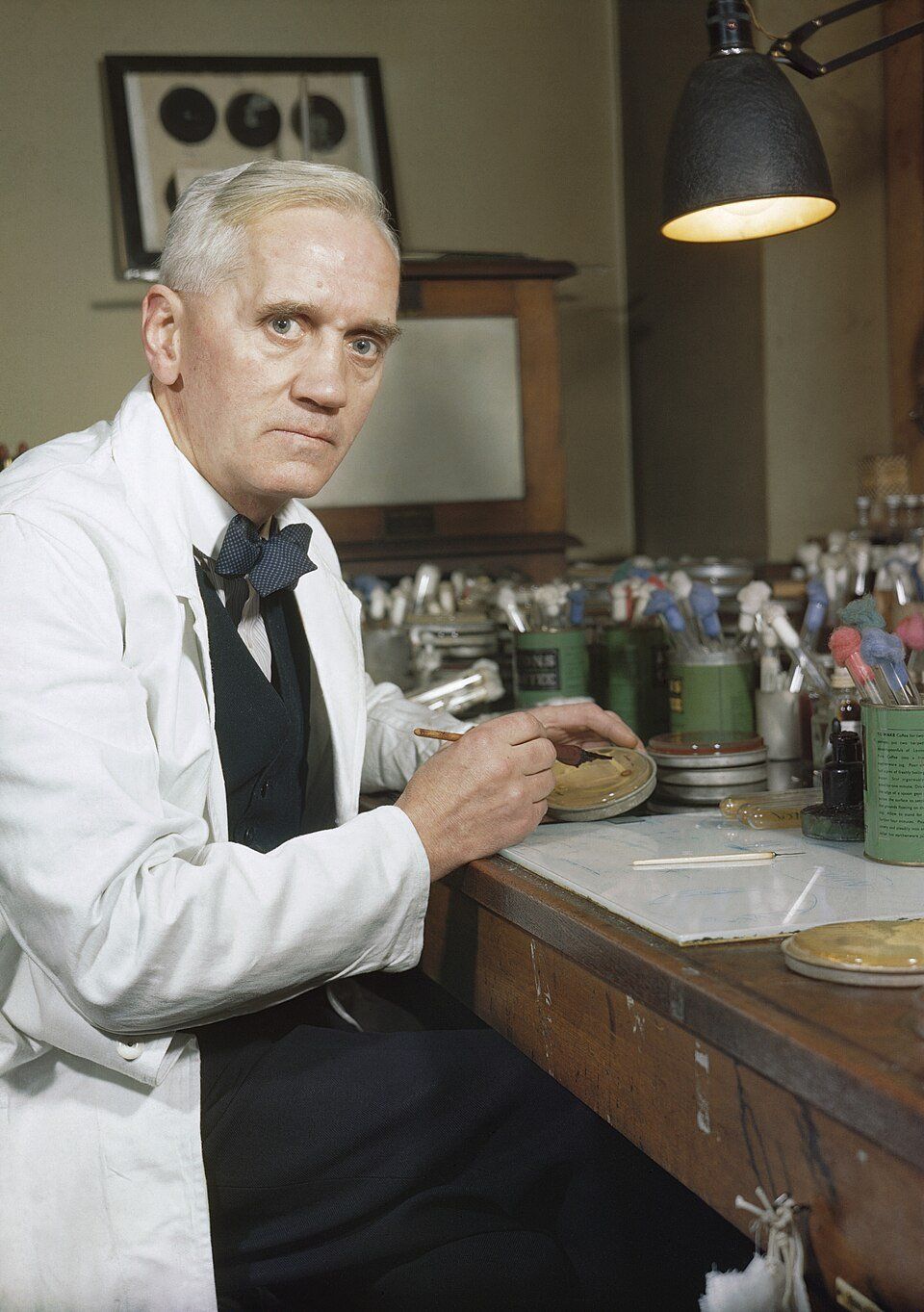
Alexander Fleming
Also known as 亚历山大·弗莱明
1881 — 1955
Physician and bacteriologist
A bacteriologist whose observation of an antibacterial mold led to the discovery of penicillin.
Saved lives stay only on this device.
The life behind the name
A life, in context
Alexander Fleming was born on a farm in Ayrshire and studied medicine at St Mary's Hospital in London. He developed a career in bacteriology and worked on infections and wound care during the First World War. His research included the body's own defenses against microbes. In 1922, he described lysozyme, an enzyme capable of breaking down some bacteria, strengthening his interest in substances that could act against infection.
In 1928, Fleming observed that a mold contaminating a bacterial culture had inhibited nearby growth. He investigated the effect and named the active material penicillin. The observation alone did not produce a dependable medicine: Howard Florey, Ernst Boris Chain and a larger research and production effort later developed ways to prepare and use penicillin effectively. Fleming shared the 1945 Nobel Prize in Physiology or Medicine with Florey and Chain. He also warned that inappropriate use could encourage resistant bacteria. His story combines attention to an unexpected laboratory result with the sustained collective work needed to transform it into a treatment that changed medical practice.
What they helped make possible
The legacy that continues
Fleming discovered penicillin's antibacterial action and identified lysozyme. The subsequent development of penicillin as a medicine depended on extensive work by other scientists and producers.
Moments along the way
A life in chapters
- 1922
Lysozyme
Described an antibacterial enzyme found in bodily secretions.
- 1928
Penicillin discovery
Investigated the antibacterial effect of a contaminating mold.
- 1945
Nobel Prize
Shared the prize with Howard Florey and Ernst Boris Chain.
Remembered together
A place to remember together.
Leave a gesture, share a thought, and keep this life close.
Following is saved to your account across devices. “Save for later” keeps a separate bookmark in this browser.
Checking your account…
A quiet moment to remember.
Customs and beliefs differ. Choose a gesture that feels right to you; each is optional.
Shared moments of remembrance
Thoughts on this life
Comments are reviewed before appearing publicly. Share a thoughtful reflection on this person’s life or work.
Suggest a profile correction
Help keep this public record accurate. Suggestions are reviewed before the profile is changed, and a source link is especially helpful for factual details.
Loading shared remembrance…
A personal practice
Carry something forward.
A legacy can begin with one small choice. Write for yourself; these words are never added to the public memorial.
Private to this browser. Turning saving off removes the saved copy. Download a copy to take it with you.
Not saved on this device.
Share this public story
A name, a story and a light to carry forward. This link opens the reviewed public page.
Create a memory book
Choose the stories to keep, arrange their chapters, and make a printable copy. Book edits apply to your exported copy.
Every life is a light. A story to keep.
7 selected chapters
Edit this chapter
Edit this chapter
Edit this chapter
Edit this chapter
Edit this chapter
Edit this chapter
Edit this chapter
Read further
Sources & further reading
Explore the published references behind this profile. These links open in a new tab.
- Nobel Prize — Alexander Fleming facts (opens in a new tab)www.nobelprize.org
- Wikipedia — Alexander Fleming (opens in a new tab)en.wikipedia.org
- Portrait: Official photographer · Public domain (opens in a new tab)commons.wikimedia.org
A place for your own remembrance
Is there someone you are remembering?
You can begin with a name and one memory. A private memorial space can hold photographs, stories and the dates your family returns to.
Private by default. You decide what to share.